Before I discovered hara hachi bu, and ran off on a tangent about 80% full and theoretical Septinas, I promised to talk about "the list," another simple concept rediscovered from a 1994 book titled Feeding on Dreams: Why America's Diet Industry Doesn't Work and What WILL Work for You, by Diane Epstein and Kathleen Thompson. The book itself takes to task the entire diet industry and how it is built on a for-profit model that doesn't work, at least in the long run, for people who want to lose weight, but, rather, works very well for companies that look to gain profits.
The authors offer some good suggestions for losing weight and keeping it off, but I was generally unimpressed until I hit the lottery ticket bookmark on page 138, and there it was, the answer I had been seeking (only I didn't know what I had been seeking until I actually saw it in print):
"List your ten favorite foods."
Then the authors had the cheek to suggest that I might actually be able to incorporate these foods into my diet, albeit on a limited basis. That what I choose to put into my body should be dictated by my preferences, not some one-size-fits-all diet program.
I was transported back to 1973, when I first embarked on a commercial weight loss program, Weight Watchers, actually. The modern WW version has come a long way in that choices are varied and that non-dieters could benefit from incorporating some of their suggestions into their ordinary lives, but, WOO! Those early days were draconian, indeed, filled with dictums and thou-shall-nots. Briefly,
1. You had to eat liver once a week, even if you despised it. To skip this instruction was tantamount to committing an unforgivable mortal sin, and the Weight Watchers' lecturer would certainly see right through your lie when she asked, "Did you eat your liver this week?" and you answered with a weak "yes."
2. You had to eat a lot of protein (at least 10 ounces a day) and little starch, a lousy rule to hand to someone who, just the week before, had fixed up an entire box of instant mashed potatoes, drizzled with a stick of melted butter, and ate until she could no longer move.
3. No dessert, except their commercial version of "ice milk," some awful, crystallized concoction, two flavors: vanilla and chocolate.
4. Only green leafy vegetables were allowed, and they had to be weighed precisely--to eat one leaf past the prescribed one cup would surely result in a five-pound weight gain for that week.
5. You had to eat three servings of fish per week--without fail. Fish, in those days, was pretty pathetic; it could usually be purchased in frozen oblongs or in cans. Fresh fish was a rarity and expensive. And even if I could have afforded fresh fish, I had no idea how to cook it as a tasty, low-fat dish. I had grown up in Iowa, where, long ago, fish had lost their fins, gained a coat of breading, and then "swam" in the deep-fryer.
6. Your three teaspoons of fat had to be spread on something, not to be used in cooking. Once, a member asked the lecturer if she could use "Pam," a then-new cooking spray, and the lecturer said, "Pam is a girl's name, and she's illegal."
Over 30 years ago, that quote still etched deep in my brain.
The point: diets, even the new updated diets with all their new (and often, tasty) convenience foods, are premised on deprivation.
And, now, here were two authors, people I have never met, telling me to develop my own list of of favorite foods, and, then, actually, offering me suggestions on how I could develop a life-long eating program that could be sustainable.
It was an important moment.
For this blog, the specifics of my personal list are unimportant, but, I must admit, I had difficulty narrowing it down to just 10 items. I'm somewhat picky, but I do like to eat, and lots of goodies kept trying to bump themselves up.
Still, when all was said and done, I wrote up my list.
Surprise.
I hadn't listed all junk food; some surprising healthy foods had bumped their way onto my list, such as sunflower seeds.
Last summer, I made an interesting discovery about sunflower seeds. Although I was still overeating, I noticed that just a small helping of sunflower seeds satisfied me, and I enjoyed them. Now they are a regular part of my diet, almost a daily treat, though I'm going to branch out and try substituting some almonds once in a while.
The important point here: these are my choices, not someone else's.
For me, that has made all the difference.
That is my epiphany.
Jennifer Semple Siegel
Septina: A New Poetic Form?
A topic definitely unrelated to the subject of this blog.
That's okay, though. I'm a writer and teacher, so it's only natural that my writing life would spill over into the personal; I can't sustain the issues of weight and relationship to food 24/7. So, readers, expect tangents like this. This blog is a work-in-progress.
In my quest to come up with interesting prompts for my creative writing students, I may have stumbled upon a new poetic form. I hesitate to call it an original idea because I'm fairly certain it's one of those ideas that people just naturally pick up on because my discovery is an offshoot of the sestina, an existing poetic form. "Septina" is definitely not an original name; on Google, septina, as a poetic form, is mentioned at least 60 times, but writers tend to talk about the problem of developing the form past that first seven-line stanza, or they develop it in a different way, not at all like a sestina. One person wanted to write a Septina but couldn't figure out how to configure the problematic last stanza.
The poet Marilyn Hacker wrote "Morning News," her version of a Septina, posted on the Forward website:
http://www.forward.com/issues/2002/02.06.07/arts4.html
But her excellent Septina consists of eight, seven-line stanzas with an end-word scheme unlike mine. Still, from what I can gather, Ms. Hacker is probably the first person to write a poem in this form, so she's probably the "inventor." But who knows? Maybe the Septina, in some form or another, has been passed around in the classroom and in writing circles. If not, it will; I plan to release it in a few days at the NCTE Exercise Exchange. Why not? It's a fascinating form, based on multiples of seven, supposedly the most perfect prime number. A good poet could write a stunning Septina, and I'd love to see some published, though modern journals tend to shy away from form poetry. For an interesting thread on the state of form poetry, click
http://foetry.com/newbb/viewtopic.php?t=146
Anyway, here's my version of the form, offered as a prompt for anyone wanting to tackle a Septina:
That's okay, though. I'm a writer and teacher, so it's only natural that my writing life would spill over into the personal; I can't sustain the issues of weight and relationship to food 24/7. So, readers, expect tangents like this. This blog is a work-in-progress.
In my quest to come up with interesting prompts for my creative writing students, I may have stumbled upon a new poetic form. I hesitate to call it an original idea because I'm fairly certain it's one of those ideas that people just naturally pick up on because my discovery is an offshoot of the sestina, an existing poetic form. "Septina" is definitely not an original name; on Google, septina, as a poetic form, is mentioned at least 60 times, but writers tend to talk about the problem of developing the form past that first seven-line stanza, or they develop it in a different way, not at all like a sestina. One person wanted to write a Septina but couldn't figure out how to configure the problematic last stanza.
The poet Marilyn Hacker wrote "Morning News," her version of a Septina, posted on the Forward website:
http://www.forward.com/issues/2002/02.06.07/arts4.html
But her excellent Septina consists of eight, seven-line stanzas with an end-word scheme unlike mine. Still, from what I can gather, Ms. Hacker is probably the first person to write a poem in this form, so she's probably the "inventor." But who knows? Maybe the Septina, in some form or another, has been passed around in the classroom and in writing circles. If not, it will; I plan to release it in a few days at the NCTE Exercise Exchange. Why not? It's a fascinating form, based on multiples of seven, supposedly the most perfect prime number. A good poet could write a stunning Septina, and I'd love to see some published, though modern journals tend to shy away from form poetry. For an interesting thread on the state of form poetry, click
http://foetry.com/newbb/viewtopic.php?t=146
Anyway, here's my version of the form, offered as a prompt for anyone wanting to tackle a Septina:
Write a "Septina," a 54-line poem consisting of seven, seven-line stanzas, and an ending quintet (five lines). The end-word scheme might be arranged as follows:
Stanza 1: 1,2,3,4,5,6,7
Stanza 2: 7,6,1,5,2,4,3
Stanza 3: 3,7,6,4,1,2,5
Stanza 4: 5,3,2,6,7,1,4
Stanza 5: 4,5,1,3,6,7,2
Stanza 6: 2,4,7,5,3,1,6
Stanza 7: 6,7,2,3,4,5,1
Stanza 8: (1,2,[3-4-5],6,7)(Five lines, three end words in line 52, or line three in the
stanza)
As the creator (?) of this particular configuration, I have not written a Septina--it looks a little intimidating. I have written a few sestinas, but they took a long time, and I'm still not all that happy with them.
I'd love to hear your thoughts, especially if you write a Septina.
Is anyone out there?
Cheers!
Jennifer Semple Siegel
A Mixed Bag: 95% Full
Baltimore, MD--Perhaps last night was a mixed bag, but I choose to view it as a victory, perhaps a 95%-full victory.
I'm definitely not perfect--I'm still a hara hachi bu person in training. I enjoyed last night's meal immensely, some favorite foods served, but I did leave food on my plate. For me, that's major, though I ultimately consumed 1,700-1,800 calories for the day--maybe more. I did notice something interesting: I was not hungry today until lunchtime, though I had awakened at 8:00 a.m. So my body seems to be learning the signs of hunger/overeating.
I ate very moderately at lunch, perhaps about one-half of my food, one-third of my dessert.
For me, that's progress.
I suspect that most normal weight people don't even think about consciously leaving food behind, but I'm not normal in the way I relate to food, and, so, I must make a conscious decision to stop eating--that's the reality, and I can't deny that flaw in my psychological makeup.
I realized that I was probably full, and, yes, 20-30 minutes later, I was content and full.
Interesting observation, though: I had to talk myself out of feeling guilt for eating "forbidden" food--another lesson to be learned--that no food is truly forbidden, just to be taken in moderation. Thin people don't obsess over these matters.
Crucial elements of my training:
--Eat what I like.
--Eat in moderation.
--Stop eating when I'm 80% full, but don't beat myself up when I "slip." Even thin people slip sometimes, and they think nothing of it.
Why should I?
I'm definitely not perfect--I'm still a hara hachi bu person in training. I enjoyed last night's meal immensely, some favorite foods served, but I did leave food on my plate. For me, that's major, though I ultimately consumed 1,700-1,800 calories for the day--maybe more. I did notice something interesting: I was not hungry today until lunchtime, though I had awakened at 8:00 a.m. So my body seems to be learning the signs of hunger/overeating.
I ate very moderately at lunch, perhaps about one-half of my food, one-third of my dessert.
For me, that's progress.
I suspect that most normal weight people don't even think about consciously leaving food behind, but I'm not normal in the way I relate to food, and, so, I must make a conscious decision to stop eating--that's the reality, and I can't deny that flaw in my psychological makeup.
I realized that I was probably full, and, yes, 20-30 minutes later, I was content and full.
Interesting observation, though: I had to talk myself out of feeling guilt for eating "forbidden" food--another lesson to be learned--that no food is truly forbidden, just to be taken in moderation. Thin people don't obsess over these matters.
Crucial elements of my training:
--Eat what I like.
--Eat in moderation.
--Stop eating when I'm 80% full, but don't beat myself up when I "slip." Even thin people slip sometimes, and they think nothing of it.
Why should I?
"Hara hachi bu" away from home
Baltimore, MD--Jerry and I are attending the annual Fulbright conference; he's an alumnus, a three-time Fulbright scholar: Yugoslavia (1988); Belgium (1997); and Macedonia (1994). I'm very proud of him--he's a brilliant guy who also happens to be very sweet and kind--no artifice there. What you see on the exterior is exactly what you get. Even my family likes him because he isn't showy or conceited. He doesn't parade his vast knowledge; consequently, sometimes people underestimate him, including yours truly.
Jerry and I connect on so many levels, weight being an issue for both of us. He, too, was a fat child--actually, at one point, an obese child. He's thin now, has been for years because of his heart; at 41, he had a massive heart attack, came very close to dying and decided to lose and keep the weight off. That was nearly 23 years ago.
But even he put on some weight in Macedonia--he says about 15 pounds. In his case, the weight slid off immediately, and he's back to pre-Macedonia weight.
People are often fooled by his exterior--he insists he's a fat man in a slim body. His mind-set = fat, and food = issues. I often say that he talks his food to death. Hell, he engages in entire conversations with his meals, asking questions, etc.
He seems to like what I'm trying to do to change my own mind-set, though he accepts me, thick or thin.
This is our first major trip away since early August, putting my resolve to the acid test. It's one thing to incorporate hara hachi bu when portions are weighed and labeled, but quite another when a humongous plate of food is shoved in front of you, prepared God-knows-how.
Here's how I view this: eating out is a reality, particularly in our lives. We attend at least four conferences a year, all of them involving major banquets. So part of the process involves dealing with food situations where external control is limited.
I refuse to live my life in a bubble, but I can still remember the concept of hara hachi bu, though caloric intake may be slightly increased, but that's not necessarily a bad thing--I've heard that a temporary increase in calories can actually boost metabolism.
Last night, we arrived in Baltimore, both of us hungry. I hadn't eaten my sunflower seeds (to be explained in another entry), because I wasn't sure what I would find.
Fortunately, the hotel has a grill, but, like most American restaurants, they serve large portions. Jerry and I decided to share a flounder, stuffed with crab, dish and rice pilaf. I ordered a side salad, no dressing. No big deal--I don't even eat dressing anyway, so it's not even a deprivation issue.
Yes, I experienced hara hachi bu, leaving the restaurant slightly hungry. Most Americans aren't used to this feeling, and, I must admit, it feels a bit scary.
But I depended on my eye to tell me that the full portion was too large for one person.
Last night was a small victory in a long, life-time marathon.
Until next time.
Jennifer Semple Siegel
Jerry and I connect on so many levels, weight being an issue for both of us. He, too, was a fat child--actually, at one point, an obese child. He's thin now, has been for years because of his heart; at 41, he had a massive heart attack, came very close to dying and decided to lose and keep the weight off. That was nearly 23 years ago.
But even he put on some weight in Macedonia--he says about 15 pounds. In his case, the weight slid off immediately, and he's back to pre-Macedonia weight.
People are often fooled by his exterior--he insists he's a fat man in a slim body. His mind-set = fat, and food = issues. I often say that he talks his food to death. Hell, he engages in entire conversations with his meals, asking questions, etc.
He seems to like what I'm trying to do to change my own mind-set, though he accepts me, thick or thin.
This is our first major trip away since early August, putting my resolve to the acid test. It's one thing to incorporate hara hachi bu when portions are weighed and labeled, but quite another when a humongous plate of food is shoved in front of you, prepared God-knows-how.
Here's how I view this: eating out is a reality, particularly in our lives. We attend at least four conferences a year, all of them involving major banquets. So part of the process involves dealing with food situations where external control is limited.
I refuse to live my life in a bubble, but I can still remember the concept of hara hachi bu, though caloric intake may be slightly increased, but that's not necessarily a bad thing--I've heard that a temporary increase in calories can actually boost metabolism.
Last night, we arrived in Baltimore, both of us hungry. I hadn't eaten my sunflower seeds (to be explained in another entry), because I wasn't sure what I would find.
Fortunately, the hotel has a grill, but, like most American restaurants, they serve large portions. Jerry and I decided to share a flounder, stuffed with crab, dish and rice pilaf. I ordered a side salad, no dressing. No big deal--I don't even eat dressing anyway, so it's not even a deprivation issue.
Yes, I experienced hara hachi bu, leaving the restaurant slightly hungry. Most Americans aren't used to this feeling, and, I must admit, it feels a bit scary.
But I depended on my eye to tell me that the full portion was too large for one person.
Last night was a small victory in a long, life-time marathon.
Until next time.
Jennifer Semple Siegel
"Hara hachi bu" or 80% Full
I love serendipity.
I'm not going to continue with my epiphany this time, because I have made another important discovery, which, in fact, is directly related to my own self-discovery.
On November 9, on the way home from work, I heard an NPR interview in which host Michele Norris interviewed Peter Menzel and Faith D'Aluisio, the authors of Hungry Planet: What the World Eats.
The authors, a married couple, traveled all over the world to see what 30 families from 24 different countries eat in a week's time.
Later, I'm going to flip over to Amazon and order the book because it sounds like a remarkable study, directly related to the issues of this blog. Menzel and D'Aluisio lived with each family for a week, shopped with them, and ate with them. The authors took pictures of the people, along with the food they consumed in a week's time. The few pictures on the NPR website are remarkable in that they show, in sharp contrast, the poverty of the third world and the wealth of the west.
No surprise: the American family profiled ate what you might expect: junk and prepared foods and lots of it. I'm not judging this family--in many ways I AM that family; otherwise, this blog and my epiphany would be irrelevant. But when Ron and Rosemary Revis of North Carolina, saw their week's worth of food laid out before them, they were shocked, so much so that they have incorporated a healthier eating regimen into their lives, along with regular exercise.
In Macedonia, my friend Ljiljiana Ordev, who lived in the U.S. during 2003, told me she was astounded at the large portions Americans ate, particularly in restaurants. We have grown accustomed to the super-sized meal, the Biggie Fries and the Big Gulp, the bigger the better. We hear all the time that Americans are getting fatter; when I was a child, childhood obesity was rare. Kids were skinny and knobby-kneed. But, now, I see obese kids all the time, and it breaks my heart because I know first-hand how other kids will and do treat them.
According to Menzel, we can learn some important information from these families, especially the one from Okinawa. In America, picky kids are told to clean their plates. After all, there are starving children in Africa, and, therefore, it is our responsibility to see that starvation doesn't happen here. I never did get the connection; I would have only been too happy to send my lima beans to these poor children--just give me the address.
But in Okinawa, children are taught to stop eating when they are 80% full--in their language: Hara hachi bu.
What a beautiful, simple concept. I have always known that normal satiety doesn't kick in until 20-30 minutes after a meal; even my alarmed grandmother told me this back in the late 50's and throughout the 1960's, but this concept was applied only to me: my skinny cousins were praised gloriously when they chowed down--a healthy, robust appetite was viewed as a sign of good health and wealth, provided you were "normal weight."
But the idea that an entire culture could embrace Hara hachi bu for everyone astounds me and offers hope, I think, for our culture as well. Why limit this concept to just the overweight? Why not encourage every American to stop eating when they are 80% full? Why single out the overweight?
Hara hachi bu suggests that overeating should be taboo for everyone feeding at the trough, not just the 200-300 pound woman or man at Old Country Buffet--that if we are going to judge people for what they eat, then we should do so in a non-discriminatory manner.
The 80%-full concept does fit in very well with my epiphany, for this is what I must do in my own life: accept and even embrace the idea of slight hunger--for the rest of my life.
Hara hachi bu will forever be a part of my vocabulary.
That's why I can never go on a diet, ever again.
Jennifer Semple Siegel
__________________
Question: I would like to hear from normal weight people who have never dieted in a significant way (other than to shed a few pounds gained during holidays and on vacation). How do you relate to food? Do you incorporate the concept of Hara hachi bu in your daily life? Please, on my blog, don't berate overweight people and insist that they are responsible for their weight--this may or may not be true. I'm more interested in finding out how you keep your weight in a normal range and how the 80%-full concept fits (or doesn't fit) into your life.
I'm not going to continue with my epiphany this time, because I have made another important discovery, which, in fact, is directly related to my own self-discovery.
On November 9, on the way home from work, I heard an NPR interview in which host Michele Norris interviewed Peter Menzel and Faith D'Aluisio, the authors of Hungry Planet: What the World Eats.
The authors, a married couple, traveled all over the world to see what 30 families from 24 different countries eat in a week's time.
Later, I'm going to flip over to Amazon and order the book because it sounds like a remarkable study, directly related to the issues of this blog. Menzel and D'Aluisio lived with each family for a week, shopped with them, and ate with them. The authors took pictures of the people, along with the food they consumed in a week's time. The few pictures on the NPR website are remarkable in that they show, in sharp contrast, the poverty of the third world and the wealth of the west.
No surprise: the American family profiled ate what you might expect: junk and prepared foods and lots of it. I'm not judging this family--in many ways I AM that family; otherwise, this blog and my epiphany would be irrelevant. But when Ron and Rosemary Revis of North Carolina, saw their week's worth of food laid out before them, they were shocked, so much so that they have incorporated a healthier eating regimen into their lives, along with regular exercise.
In Macedonia, my friend Ljiljiana Ordev, who lived in the U.S. during 2003, told me she was astounded at the large portions Americans ate, particularly in restaurants. We have grown accustomed to the super-sized meal, the Biggie Fries and the Big Gulp, the bigger the better. We hear all the time that Americans are getting fatter; when I was a child, childhood obesity was rare. Kids were skinny and knobby-kneed. But, now, I see obese kids all the time, and it breaks my heart because I know first-hand how other kids will and do treat them.
According to Menzel, we can learn some important information from these families, especially the one from Okinawa. In America, picky kids are told to clean their plates. After all, there are starving children in Africa, and, therefore, it is our responsibility to see that starvation doesn't happen here. I never did get the connection; I would have only been too happy to send my lima beans to these poor children--just give me the address.
But in Okinawa, children are taught to stop eating when they are 80% full--in their language: Hara hachi bu.
What a beautiful, simple concept. I have always known that normal satiety doesn't kick in until 20-30 minutes after a meal; even my alarmed grandmother told me this back in the late 50's and throughout the 1960's, but this concept was applied only to me: my skinny cousins were praised gloriously when they chowed down--a healthy, robust appetite was viewed as a sign of good health and wealth, provided you were "normal weight."
But the idea that an entire culture could embrace Hara hachi bu for everyone astounds me and offers hope, I think, for our culture as well. Why limit this concept to just the overweight? Why not encourage every American to stop eating when they are 80% full? Why single out the overweight?
Hara hachi bu suggests that overeating should be taboo for everyone feeding at the trough, not just the 200-300 pound woman or man at Old Country Buffet--that if we are going to judge people for what they eat, then we should do so in a non-discriminatory manner.
The 80%-full concept does fit in very well with my epiphany, for this is what I must do in my own life: accept and even embrace the idea of slight hunger--for the rest of my life.
Hara hachi bu will forever be a part of my vocabulary.
That's why I can never go on a diet, ever again.
Jennifer Semple Siegel
__________________
Question: I would like to hear from normal weight people who have never dieted in a significant way (other than to shed a few pounds gained during holidays and on vacation). How do you relate to food? Do you incorporate the concept of Hara hachi bu in your daily life? Please, on my blog, don't berate overweight people and insist that they are responsible for their weight--this may or may not be true. I'm more interested in finding out how you keep your weight in a normal range and how the 80%-full concept fits (or doesn't fit) into your life.
The Epiphany: The Lottery Ticket
Actually, my epiphany wasn't all that stupendous, at least on the surface. But the flash was significant for me: I couldn't embark on yet another diet.
That's right. No more diets. Ever.
Instead, as of August 28, 2005, I was starting another journey: making a major change in the way I approach food and how I choose to eat.
Let's back track. Back in the early nineties, I bought into the then-popular "Eat-what-you-want-and-your-body-will-tell-you-when-you're-hungry" program. I even wrote a short essay titled "Are You Thin Yet?" published in Eating Our Hearts Out: Personal Accounts of Women's Relationship with Food (1993), edited by Leslea Newman. At the time, it was a heartfelt essay, written with good intentions, but I kept waiting for my body to kick in that appestat control.
It never did. I felt like some kind of freak whose "natural" appetite was cranked into overdrive. And despite my very public promise to never fall into the diet trap, I did--several times, the last major diet in 1999; I lost about 80 pounds, but with the help of phentermine, and despite the diet pill, I was still always hungry--I'm one of those people who tend to experience the "opposite" effects from medication. Still, I more or less kept the weight off for about two years, probably the longest time I have ever sustained a weight loss. But, over time, the pounds crept upward, and by 2003 I was pretty much back to where I started in 1999. Since 2003, I have had several mini-diet starts, the longest lasting three months.
Back to August 28. The night before, I had been on this diet for about three weeks, and I caved, bingeing on ballpark potato chips and a health bar, some chocolate peanut butter glob that tasted like a sugared super vitamin.
I had sunk to an all-time low. It wasn't even creative: just a cheap binge--I had sold out my diet for a tasteless handful of greasy chips and an oblong of artificially manufactured block of protein that buffos use in place of an entire meal. I could have at least done the dirty deed right by glomming down on a Dairy Queen Caramel Moolatte (extra whipped cream--why the hell not?).
But, no.
The next morning, I vowed to pick myself up, and start from square one.
Then, the little voice: "I can't do this anymore."
The tight-jawed determination. The promises. The wavering. The fall. The self disgust. The vicious cycle redux.
Still, I dragged out all the diet books, some of them over 30 years old--at 55, I've been doing this diet thing a long time.
I'm a professional dieter. I have weights and measures memorized, and I can look at a hunk of meat and guess accurately its weight and calorie count. I know good and bad proteins, carbs, sugars. I can calculate glycemic quotients.
I just can't keep off extra weight.
I look at thin people and wonder how they sustain their normal weights. I want to know their secrets, not just the cliched input/output model. I already know that. I want to know how they relegate food to the realm of ordinary, how they don't obsess about Moolattes and homemade mashed potatoes drowning in butter. Even babies know when to stop eating--I'm being bested by beings who still mess their pants and throw their nummies on the floor. Future fatties are not usually born that way--they learn it somehow, just like I had.
I remember my first binge: I was 7 and gorged on three glazed doughnuts. Then my grandparents took me for a ride on the L.A. freeway. In the middle of summer. In the days before ordinary people had car airconditioning. Bumper-to-bumper traffic.
I hurled, shooting doughnut chunks right into the next car...
Well, all I can say: I lived to tell about it.
I went on my first diet when I was 8, my main meal of the day involving all the lettuce I wanted, sprinkled with sugar. By 9, I was on a pink diet pill and a gray thyroid pill that I chewed because I was so hungry all the time, and it tasted like a morsel of food. Then my doctor prescribed a downer because the diet pill wired me, and I couldn't sleep, which meant I couldn't get up for school.
For some inexplicable reason, I never became an addicted abuser of pills, alcohol, or illegal drugs, though it wasn't for lack of trying. I thoroughly enjoyed the illicit fruits of the 1960's.
My fatal flaw and downfall has always been an unhealthy relationship with food.
Food isn't a substance one can stop cold turkey. That's known as anorexia, and I have flirted with that, too, but not in recent years. I'm nipping at the heels of senior citizenship, and to totally stop eating now would certainly hasten my trek into the hereafter--not quite there yet. But when I was in high school, I often fasted for three days at a time, cultivating that gaunt face that teenagers seem to like. I drew pictures of sickly-looking girls with long pale hair, ghostly glowing skin, black smudged eyeliner framing liquid blue eyes, and pink--almost white--lips.
No longer an option.
So here's my epiphany: I can't get rid of my substance of choice; I can't stub out that last bread crust, toss out my stash of hamburger, and vow to NEVER take a bite of food, as long as I live.
Every day, I will wake up and, first thing, inhale my coffee. Sooner or later, I will feel that first pang that will send me on the hunt for sustenance. Feed the kitty.
Denying the kitty its feed = stoking the monster's wrath.
Dieting = stoking the up appestat.
Never fails.
Denying the body what it needs and wants = failure.
I've always known this, of course, but my knowledge was abstract and superficial. I didn't really know, at least not deep in my gut. During the nineties, I made a stab at this reality, but I misinterpreted it as license to eat whatever I wanted, without guilt, and that this mythical appetite control would kick in and, kum-ba-ya, hello, road to thinness.
This approach may have worked for some people, but not for me. I just kept eating, a juggernaut eating machine, devouring whatever nuggets lay in my path.
And as I yo-yoed up and down, the nineties morphed into the oughts.
2005. Right on my book shelf, I found an 11-year-old paperback with a 1990 Pennsylvania Super 7 lottery ticket tucked between pages 138 and 139. Pennsylvania used to print out such colorful tickets, with pictures of interesting state landmarks--this one depicts Pittsburgh and its three rivers. I can't claim it's a winning ticket--otherwise, I'd have a few cool million in the bank, and the ticket would be framed in gesso and hanging on my wall, instead of stashed in a yellowed paperback, but if you're superstitious and believe in fate, the numbers are 1, 15, 31, 41, 50, 64, 70. Date of ticket: January 17, 1990. Maybe those numbers have meaning, too. You figure it out.
Numbers have always gotten me into trouble: number of calories, number of ounces, numbers on the scale, number of inches around my waist and hips--count this, count that...
The lottery ticket itself isn't so important, but where I found it is. On page 139, the author instructs the reader to list 10 favorite foods.
That I might be able to acknowledge my 10 favorite foods--without guilt--may turn out to be one of the most important revelations of my life.
Next time: the meaning of the list.
_______________________
Jennifer Semple Siegel
That's right. No more diets. Ever.
Instead, as of August 28, 2005, I was starting another journey: making a major change in the way I approach food and how I choose to eat.
Let's back track. Back in the early nineties, I bought into the then-popular "Eat-what-you-want-and-your-body-will-tell-you-when-you're-hungry" program. I even wrote a short essay titled "Are You Thin Yet?" published in Eating Our Hearts Out: Personal Accounts of Women's Relationship with Food (1993), edited by Leslea Newman. At the time, it was a heartfelt essay, written with good intentions, but I kept waiting for my body to kick in that appestat control.
It never did. I felt like some kind of freak whose "natural" appetite was cranked into overdrive. And despite my very public promise to never fall into the diet trap, I did--several times, the last major diet in 1999; I lost about 80 pounds, but with the help of phentermine, and despite the diet pill, I was still always hungry--I'm one of those people who tend to experience the "opposite" effects from medication. Still, I more or less kept the weight off for about two years, probably the longest time I have ever sustained a weight loss. But, over time, the pounds crept upward, and by 2003 I was pretty much back to where I started in 1999. Since 2003, I have had several mini-diet starts, the longest lasting three months.
Back to August 28. The night before, I had been on this diet for about three weeks, and I caved, bingeing on ballpark potato chips and a health bar, some chocolate peanut butter glob that tasted like a sugared super vitamin.
I had sunk to an all-time low. It wasn't even creative: just a cheap binge--I had sold out my diet for a tasteless handful of greasy chips and an oblong of artificially manufactured block of protein that buffos use in place of an entire meal. I could have at least done the dirty deed right by glomming down on a Dairy Queen Caramel Moolatte (extra whipped cream--why the hell not?).
But, no.
The next morning, I vowed to pick myself up, and start from square one.
Then, the little voice: "I can't do this anymore."
The tight-jawed determination. The promises. The wavering. The fall. The self disgust. The vicious cycle redux.
Still, I dragged out all the diet books, some of them over 30 years old--at 55, I've been doing this diet thing a long time.
I'm a professional dieter. I have weights and measures memorized, and I can look at a hunk of meat and guess accurately its weight and calorie count. I know good and bad proteins, carbs, sugars. I can calculate glycemic quotients.
I just can't keep off extra weight.
I look at thin people and wonder how they sustain their normal weights. I want to know their secrets, not just the cliched input/output model. I already know that. I want to know how they relegate food to the realm of ordinary, how they don't obsess about Moolattes and homemade mashed potatoes drowning in butter. Even babies know when to stop eating--I'm being bested by beings who still mess their pants and throw their nummies on the floor. Future fatties are not usually born that way--they learn it somehow, just like I had.
I remember my first binge: I was 7 and gorged on three glazed doughnuts. Then my grandparents took me for a ride on the L.A. freeway. In the middle of summer. In the days before ordinary people had car airconditioning. Bumper-to-bumper traffic.
I hurled, shooting doughnut chunks right into the next car...
Well, all I can say: I lived to tell about it.
I went on my first diet when I was 8, my main meal of the day involving all the lettuce I wanted, sprinkled with sugar. By 9, I was on a pink diet pill and a gray thyroid pill that I chewed because I was so hungry all the time, and it tasted like a morsel of food. Then my doctor prescribed a downer because the diet pill wired me, and I couldn't sleep, which meant I couldn't get up for school.
For some inexplicable reason, I never became an addicted abuser of pills, alcohol, or illegal drugs, though it wasn't for lack of trying. I thoroughly enjoyed the illicit fruits of the 1960's.
My fatal flaw and downfall has always been an unhealthy relationship with food.
Food isn't a substance one can stop cold turkey. That's known as anorexia, and I have flirted with that, too, but not in recent years. I'm nipping at the heels of senior citizenship, and to totally stop eating now would certainly hasten my trek into the hereafter--not quite there yet. But when I was in high school, I often fasted for three days at a time, cultivating that gaunt face that teenagers seem to like. I drew pictures of sickly-looking girls with long pale hair, ghostly glowing skin, black smudged eyeliner framing liquid blue eyes, and pink--almost white--lips.
No longer an option.
So here's my epiphany: I can't get rid of my substance of choice; I can't stub out that last bread crust, toss out my stash of hamburger, and vow to NEVER take a bite of food, as long as I live.
Every day, I will wake up and, first thing, inhale my coffee. Sooner or later, I will feel that first pang that will send me on the hunt for sustenance. Feed the kitty.
Denying the kitty its feed = stoking the monster's wrath.
Dieting = stoking the up appestat.
Never fails.
Denying the body what it needs and wants = failure.
I've always known this, of course, but my knowledge was abstract and superficial. I didn't really know, at least not deep in my gut. During the nineties, I made a stab at this reality, but I misinterpreted it as license to eat whatever I wanted, without guilt, and that this mythical appetite control would kick in and, kum-ba-ya, hello, road to thinness.
This approach may have worked for some people, but not for me. I just kept eating, a juggernaut eating machine, devouring whatever nuggets lay in my path.
And as I yo-yoed up and down, the nineties morphed into the oughts.
2005. Right on my book shelf, I found an 11-year-old paperback with a 1990 Pennsylvania Super 7 lottery ticket tucked between pages 138 and 139. Pennsylvania used to print out such colorful tickets, with pictures of interesting state landmarks--this one depicts Pittsburgh and its three rivers. I can't claim it's a winning ticket--otherwise, I'd have a few cool million in the bank, and the ticket would be framed in gesso and hanging on my wall, instead of stashed in a yellowed paperback, but if you're superstitious and believe in fate, the numbers are 1, 15, 31, 41, 50, 64, 70. Date of ticket: January 17, 1990. Maybe those numbers have meaning, too. You figure it out.
Numbers have always gotten me into trouble: number of calories, number of ounces, numbers on the scale, number of inches around my waist and hips--count this, count that...
The lottery ticket itself isn't so important, but where I found it is. On page 139, the author instructs the reader to list 10 favorite foods.
That I might be able to acknowledge my 10 favorite foods--without guilt--may turn out to be one of the most important revelations of my life.
Next time: the meaning of the list.
_______________________
Jennifer Semple Siegel
A New Life Journey
HELLO! e-Fatlady would love to hear your anecdotes (the good, bad, funny, and ugly) about navigating, as a fat person, your way through a thin world.
If you are a thin person living with a fat person, how does that affect your day-to-day life?___________________
I posted the above over a year ago, on July 7, 2004, at 11:27 p.m.; I was in a different place back then, and wished to be anonymous. I no longer feel that way. I'm not going to post anything I wouldn't want my family and friends to see; as a result, I have changed my profile to reflect my openness. I have no desire to hide in cyberspace.
As I enter into late middle age, I have embarked on a new journey, which began on August 4, 2005--only I didn't realize it at the time.
I thought I was beginning "another diet." I had just returned from a year's stay in Skopje, Macedonia, where the food tends to be fatty, both good (olive oil) and bad (animal) fat. I, of course, gained weight, about 15 pounds, maybe more. Macedonia, a developing country, has many of the same conveniences that we do, except not as much variety. Diet foods are almost unheard of, so if one wants to cook low fat, we're talking about "from scratch." No Chef Lean Cuisine or Healthy Choice, though Coke Light and artificial sweetners (in liquid--probably the same cyclamates banned years ago in the U.S.--and pill form) are readily available. Like the good perennial dieter, I
used these products, even as I stuffed myself on pizza, fries, and Big Macs--yes, there are at least three McDonald's franchises in Skopje alone.I didn't bother to cook much; I hate to cook. I remain fundamentally opposed to spending two hours preparing a meal that takes 10-15 minutes to consume. So my husband Jerry and I ate out a lot--very inexpensive in Skopje, about $7.00-$8.00 at the local pizzeria for both of us, including shots of Mastika (licorice-flavored white lightning) or Rakjia (yellow or white lightning). Even my skinny husband piled on a few pounds, which he has quickly shed. Men!
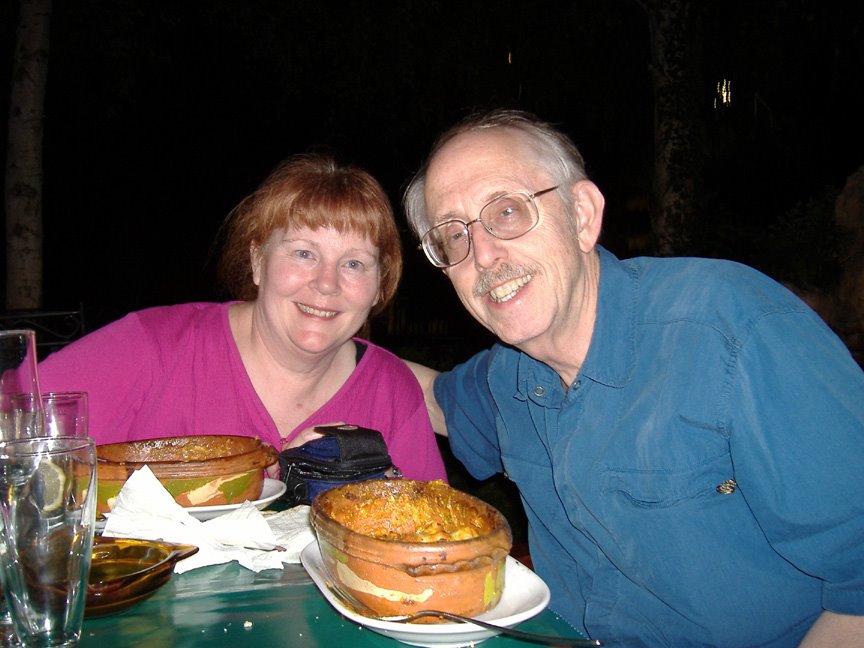
(July 5, 2005: Jerry and I enjoy a farewell-to-Macedonia dinner at "511," a local pizzeria)
During my time in Macedonia, I didn't realize the significance of this following observation: that despite their high fat diet, Macedonians tend to be thin. Obesity is rare. Morbid obesity is unheard of--on the street, I saw one Macedonian who might be considered obese, and that was a stretch.
I must admit, I sometimes felt a little out of place, but I still enjoyed my time there, writing, visiting friends, shopping, walking, traveling (Rome and Athens!), and going out. Surprisingly, I experienced very little blatant discrimination against me because of my size--I can probably count on one hand the times I felt belittled because of the way I look. Most of my self-consciousness was self generated.
Fat prejudice is much worse in the U.S.; even as our culture gets fatter, discrimination against the overweight is heaped higher, evidenced by insensitive talk show hosts and a domestic airline that will remain unnamed. But that's another issue to be explored in another entry.
The truth is, weight regulation is a complex biological process that goes beyond the simplistic input/output formula touted by some righteous thin people for whom weight regulation and appetite control are unconscious processes. Even scientists and researchers are baffled why some people hang onto weight, while others slough it off effortlessly, as evidenced by a lack of diet aids that (1) truly work, (2) are safe, (3) don't involve risky major surgery.
My difficulty has always been appetite control. When I was 10, my grandmother told me, "You eat like a man." She was right; I could eat any teenage boy under the table. Set me loose at a buffet, and I'd go back to the groaning table three or four times. I just couldn't fill up--not until I was so stuffed that my stomach hurt.
Even so, as a kid, I was only slightly overweight. To this day, I'm convinced that if my grandparents (who raised me) had left me alone and not stuck me on myriad diets, my appetite and weight might have evened out, though I'll never know for sure. But I'm finished playing the blame game. My family did what they felt was best for me--
I'm moving on.
So why are most Macedonians thin? I have arrived at some conclusions:
- Less variety at the grocery store and market. Go to any U.S. supermarket, and you will often find hundreds of choices for one kind of item. Macedonian markets tend to offer two or three choices--get over it.
- Very little food advertising on TV and billboards. Restaurant ads tend to focus on the facility and less on the food itself. Conversely, take a good look at U.S. food ads--close up shots of super-sized hamburgers, dripping with grease and melting cheese, and deep fried chicken fingers.
- Meals are special events, not just food-on-the-run. At least once a day, families eat together--and it's not a hurried process; diners take their time.
- Macedonian portions are smaller; the "doggie bag" is just beginning to seep into the Macedonian psyche and only because the increasing American presence started it. (Guilty!) So the high fat diet is probably turns out to be lower in calories.
- Macedonians eat their main meal of the day around 2:00 p.m. Supper consists of "Mezes," a light spread typically eaten at the coffee table, garnished with plenty of conversation and a shot of rakjia or goblet of wine. Sometimes both.
- Macedonians tend not to snack between meals. Even food grabbed on the run, such as roasted chestnuts sold on the streets, is considered a meal. To me, they were a snack.
- Macedonians tend to walk more. It's not unusual to weave one's way downtown through a crowd--center city Skopje always seems to be hopping with activity: festivals, craft shows, concerts, even fireworks.
- Macedonians smoke a lot; obviously, this isn't a recommended weight-control aid, but, often, when people hang out at cafes and bars, they are drinking coffee or rakija and smoking, not eating fast food.
- One aspect that can't be ignored: poverty. Certainly poverty does play a major role in the physical makeup of the Macedonian population; for example, many of the Roma population are extremely thin because of want, not because they are counting calories.
- Dieting is not yet a national obsession; the weight-loss industry, such as it is, is still in its infancy. A friend, not overweight, was going to a diet doctor for some kind of (yikes!) injections for weight control.
Number 10 demonstrates that, over time, Macedonia and other former communist countries will pick up many of our bad food and dieting habits, but in 2004 and 2005, they still relate to food in a fairly healthy manner.
So why didn't I come home thinner instead of fatter?
The simple answer: Jerry and I brought our American culture with us. While we tried, in public, to "blend" in, at home we retained our old habits. We ate our main meal at six or seven, and I didn't change any of my eating habits--I even developed a few other bad habits, such as developing a taste for cappuccinos with whipped cream, and not as a substitute for meals. The food in restaurants was tasty and fatty, and we ate out a lot.
A different story in 1988-89, another year in Macedonia--then part of Yugoslavia--and I did return home 15 pounds lighter. But it was a different place then, food choices at the market limited to what was in season, sometimes the shelves bare--and Tito's ghost still very evident. No internet, no computer, no CNN: we were truly isolated back then. Five Americans lived in Skopje, we making up 40% of the American population. We truly lived on the Yugoslav economy, which means that, in the cold winter months, we ate a lot dishes made from dried beans, pasta, cabbage, leeks, tomato paste, tuna, and rice--it's really difficult to gain weight on such fare. Junk food was rare, and what existed tasted terrible, at least to the spoiled Western palate. Going out was inexpensive, but pizzerias were rare and not that that great. The main restaurant staple was steak, and you had to ask the server "to hold the fried egg on top." I'm not a big steak fan. They didn't even serve cappuccino back then--just Turkish coffee, which consists of a brew boiled directly in coffee grounds, an acquired taste. It was just easier not to eat as much.
Back to August 4. I had been back in the states about a month, just returned from a two-week trip to Sioux City, Iowa, to visit family. I felt depressed, uncomfortable, and bloated, having indulged even beyond the previous 10 months. Pigged out. So I went on a diet, the same old song of my life, got out all the dusty diet books and began reading about the ways I'd need deprive myself for the next six or seven months.
Ho-hum. For about three weeks, I stuck to my plan. But then the cravings came, and on August 27, I caved, and binged. It wasn't an all-out binge, but, in my mind, it was a failure, close to a moral lapse.
I would have to start over.
Then something amazing happened, an epiphany.
Until next post...
_______________
My question: In the long run, do diets really work? I would like to hear some success and horror stories.
My original invitation still stands; you are still welcome to post your stories.
Jennifer Semple Siegel
Subscribe to:
Posts (Atom)